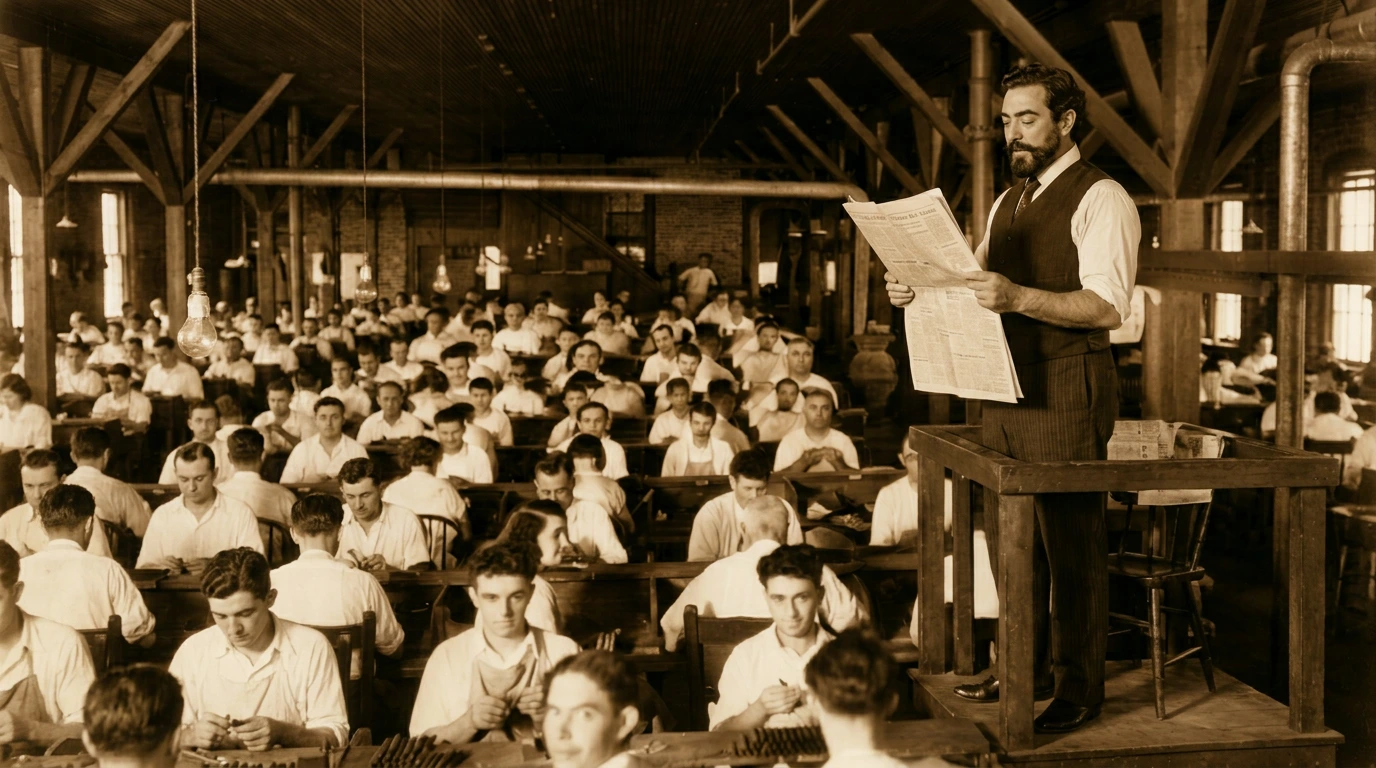
Before podcasts, audiobooks, or talk radio, there was the lector, a person who stood on an elevated platform inside a cigar factory and read aloud to hundreds of hand-rollers every single working day. They covered daily newspapers, classic novels, and political philosophy, and their influence on the workforce ran so deep that factory owners in Cuba eventually had them banned. It's one of the most fascinating traditions in cigar history, and most people who smoke have never heard of it.
- Before podcasts, before audiobooks, cigar factories in Cuba and Florida had lectors -- men and women who stood at a raised platform and read aloud to rolling floors of 200+ workers for hours every day.
- The tradition shaped the political consciousness of the labor movement, got multiple lectors fired or exiled, and left a mark on cigar culture that still shows up in how smokers think about the ritual of a good cigar.
- The practice mostly died out in the 20th century, but a few factories still carry it on -- one of the most human traditions in any industry, anywhere.
The practice began in Cuba in 1865, spread to Key West and Tampa as Cuban cigar workers emigrated, and left a cultural fingerprint on the cigar industry that most smokers today have never heard about. This is who the lectores were, how the tradition worked, why it mattered, and what eventually brought it to an end.
WHAT IS A LECTOR?
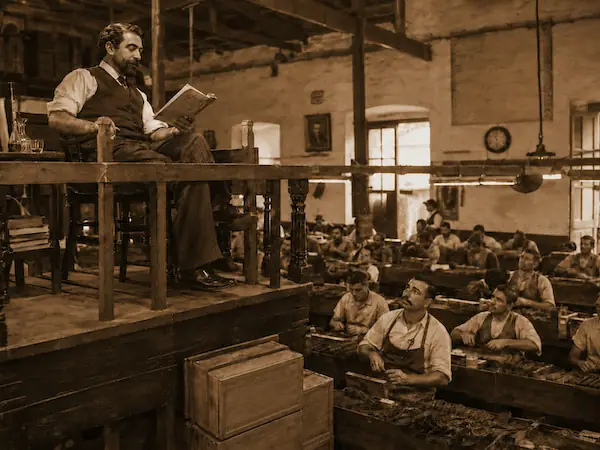
The word is Spanish for "reader," but that translation barely does the job justice. A lector was not just someone who flipped through a newspaper and read headlines out loud. The role was part performer, part educator, part community voice, and part political agitator - depending on the day, the factory, and the reading material the workers had voted to hear.
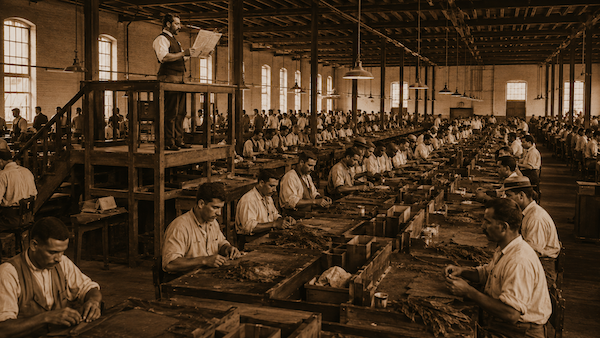
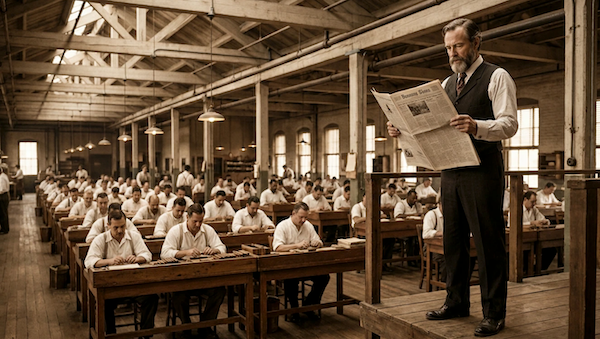
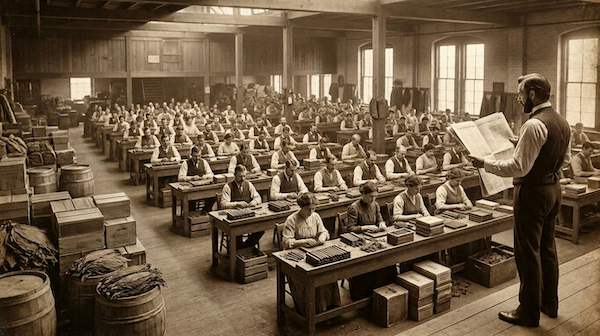
The setup was practical and elegant at the same time. The lector sat or stood on a raised platform at the center of the factory floor called the tribuna, positioned so every rolling station in the room could hear a single clear voice above the quiet rhythm of hands working tobacco. The workers kept rolling while the lector read, and every person in that room was listening.
What makes this tradition genuinely remarkable is who paid for it. The lectors were not hired by the factory owners. They were hired and paid by the workers themselves through a voluntary contribution of around 25 cents a week per worker. The workers also voted on what was read. That combination - worker-funded and worker-directed education delivered inside the workplace - was unlike anything else happening in the industrial world of the 19th century.
WHERE AND WHEN IT STARTED
The origin story is well-documented and specific. The tradition of reading aloud in Cuban cigar factories began on December 21, 1865, at the El Figaro factory in Havana. The driving force behind that first formal reading was Nicolas Azcárate, a Cuban political liberal and advocate for worker education. Saturnino Martinez, a Spanish journalist and poet who founded the worker education newspaper La Aurora, was a connected figure in that same literacy movement.
The earliest lectores were actually cigar workers themselves who took turns reading aloud every half hour while their coworkers compensated them for the production time they lost. The role quickly became a paid, dedicated position as the practice spread to factories across Havana and beyond.
There is also a parallel version of the origin story pointing to the town of Bejucal, where a reader named Antonio Leal reportedly began the practice in 1864 - one year before the Havana accounts. Cuban scholar Fernando Ortiz documented this version, citing Reverend Manuel Deulofeo as the source. Either way, by 1865 the tradition was firmly established in Havana.
THE TRIBUNA: THE MOST IMPORTANT PLATFORM YOU'VE NEVER HEARD OF
The physical centerpiece of the entire lector tradition was the tribuna. This elevated platform - usually positioned at the center or front of the rolling floor - was raised high enough so the lector's voice could travel across a room full of people working in focused quiet, reaching every rolling station without shouting.
"He reads books and newspapers at top of his voice all day long. This is all the education many of these workers receive. He is paid by them and they select what he shall read."
- 1909 TAMPA FACTORY PHOTOGRAPH CAPTION
Think about what that platform represented. In a factory where management controlled nearly everything, there was a structure built by workers, for workers, paid for by workers, and occupied each day by a voice those workers had chosen themselves. The tribuna was not just furniture. It was a symbol of something workers had decided they were entitled to: a working life that fed the mind as well as the stomach.
When a reading landed well, workers would bang their curved rolling knives - called chavetas - on the surface of their tables in appreciation. Dozens of blades rattling against wood in approval. That must have been something to hear.
THE TRADITION MOVES TO FLORIDA
When political instability and Spanish colonial pressure pushed Cuban cigar workers out of Havana in the late 19th century, they brought everything with them. Their skills, their culture, and their lectores all made the crossing. Key West received the tradition first, as early as 1865, and Tampa followed as Ybor City grew into one of the most vibrant cigar-producing neighborhoods in the United States - eventually housing over 150 factories and a deeply Cuban cultural identity.
Tampa factory workers continued the same model that had worked in Havana: democratic voting on reading material, worker-funded salaries, and a single voice rising from the tribuna to fill the workday with something more than silence.
WHAT THE LECTORES ACTUALLY READ
The lectors did not stick to soft reading. They covered enormous ground, and the selections said a lot about what the workers cared about.
Newspapers were a daily fixture. Workers wanted to know what was happening in Cuba, in Florida, in the wider world. The lector was often the fastest way that information reached people working ten-hour days with limited time to read for themselves.
Novels were enormously popular. Authors like Charles Dickens, Victor Hugo, Alexandre Dumas, Emile Zola, Miguel de Cervantes, and Leo Tolstoy became fixtures of the factory floor. The serialized nature of the readings meant workers would listen to chapters every day, talk about the characters during lunch, and return the next morning genuinely eager to hear what happened next.
Political and philosophical texts were perhaps the most consequential readings of all. Works by thinkers across the political spectrum contributed directly to the rise of labor organizing, union movements, and political consciousness among cigar workers. Factory owners understood this clearly - which is a big part of why they hated the lectors. The workers were essentially paying to have challenging ideas delivered to them every single day, and management had no say in the reading list.
THE LECTOR AS A CULTURAL FORCE
The lectores were a genuine cultural force, and the cigar factories where they worked became unusual centers of learning and debate at a time when working-class access to education was severely limited. Cigar rollers in Tampa and Havana were frequently described as among the most educated and politically aware workers anywhere in the labor force - not because of schools or universities, but because of the tribuna in the middle of the rolling room.
Even José Martí, the poet and revolutionary who became the father of Cuban independence, delivered speeches from lector platforms at cigar factories in Tampa and New York. A lector named Francisco Maria González transcribed Martí's now-famous Tampa address at one of those factory gatherings. The cigars were being rolled on the outside and a revolution was being assembled on the inside.
FACTORY OWNERS AND THE CONFLICT
The relationship between the lectores and factory management was almost universally tense. Owners were not part of the selection process and had no control over what was read. They watched their workers become increasingly educated, politically organized, and willing to push back on poor working conditions - and they made a direct connection to the voice coming from the tribuna.
Factory owners in Cuba repeatedly tried to restrict or ban lectores, often with support from Spanish colonial authorities who were equally uncomfortable with a workforce reading material about independence and labor rights. In the United States, owners made similar attempts, characterizing the readings as political propaganda. Both sides were right about what was happening. They simply disagreed on whether it was a problem.
THE BEGINNING OF THE END
The golden era of the lector ran roughly from 1865 through the 1920s, with pockets of the tradition surviving longer in some places. Several forces combined to bring it to a close.
Mechanization was arguably the most decisive blow. As cigar production became increasingly mechanized in the late 1920s, the noise of the machines made it impossible for a single human voice to carry across the factory floor. The quiet room that the lector had always depended on simply ceased to exist.
The Great Depression deepened the wound. Cigar sales dropped sharply as smokers switched to cheaper cigarettes, and workers could no longer afford the weekly contribution that funded the lector position.
Factory owner opposition accelerated things further. Lectors were involved in major strikes in 1920 and 1931. After the 1931 strike, factory owners began removing the role systematically. Workers who returned found the tribuna empty.
Radio played a supporting role in the decline, though it is worth noting that in many factories the lector and the radio coexisted for some years. Many workers preferred the human voice they had voted for over a broadcast from somewhere they had no control over.
WHY IT STILL MATTERS
In Cuba, the lector tradition has survived in a small number of factories as a recognized cultural practice. The H. Upmann factory in Havana is among the places most associated with keeping some form of the tradition alive, though its modern role is ceremonial compared to the daily necessity it once served.
Beyond Cuba, the legacy of the lectores shows up in unexpected places. The audiobook industry - now worth billions globally - is built on exactly the same human desire the lectores served: the wish to receive stories and information through the ears while the hands and body are busy doing something else. The lector understood that about human attention long before anyone had a name for it.
More broadly, the story of the lectores is a story about what workers built for themselves when nobody else was building it for them. They decided that a good working life required more than a wage. It required stories, ideas, news, debate, and the daily stimulation of a curious mind. They pooled their money, chose their reader, climbed up to the tribuna, voted on what they wanted to hear, and created an intellectual community inside a factory floor.
That is not a minor detail in cigar history. That is one of the most interesting things the cigar industry ever produced - and it had nothing to do with tobacco.
GLOSSARY
| TERM | DESCRIPTION |
|---|---|
| Lector | A professional reader employed by cigar factory workers to read aloud during the workday. Paid by the workers themselves, not management, from a raised platform called the tribuna. |
| La Tribuna | The raised wooden platform inside a cigar factory from which the lector read. Positioned so the reader's voice could carry across the entire rolling floor. |
| Torcedor | A trained cigar roller. The word is Spanish for "one who twists." Torcedores were the primary audience for the lector's readings during their long rolling shifts. |
| Vuelta Abajo | Cuba's most prized tobacco-growing region in Pinar del Río, and the birthplace of the lector tradition. The factories of Havana and later Ybor City carried the practice forward. |
| Ybor City | A neighborhood in Tampa, Florida, founded in 1885 as a center of Cuban and Spanish cigar manufacturing. Home to hundreds of factories that employed lectors until the 1931 strike. |
| El Figaro Factory | The Havana cigar factory where the first formal lector reading took place on December 21, 1865, organized by Nicolás Azcárate. |
| Nicolás Azcárate | Cuban liberal politician and worker education advocate who organized the first official lector reading in 1865. A key figure in connecting cigar labor culture with literacy and political consciousness. |
| Intangible Cultural Heritage | A UNESCO designation recognizing cultural practices, traditions, and knowledge systems of outstanding value. The Cuban cigar lector tradition holds this recognition. |
FREQUENTLY ASKED QUESTIONS
Everything you want to know about the cigar factory lector tradition.