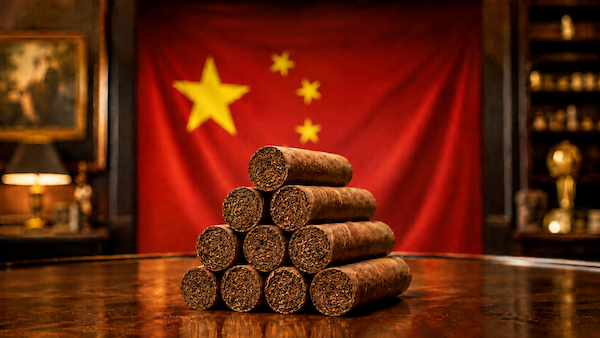
In less than a decade, Cohiba transformed from the world's most famous premium cigar into a full-blown luxury asset - and the story behind that transformation involves an alleged fugitive fraud kingpin, a billion-dollar acquisition through shell companies, record-breaking auction bids from Chinese nationals, and a Spanish holding company now teetering on the edge of insolvency. This is not just a story about tobacco prices. It is an investigative look at who really owns the Cuban cigar business, how it got there, and what it means for every serious cigar smoker who has watched their favorite Cohiba double in price and then disappear from shelves.
- Asian-backed investors linked to an alleged fraud kingpin quietly acquired the commercial half of Habanos S.A. through a web of shell companies in 2021.
- China is now the world's #1 market for Cuban cigars, and that shift is the primary reason Cohiba prices doubled and never came back.
- The ownership situation is still unresolved, and what happens next will shape the future of Cuban cigars for every serious smoker on the planet.
THE QUESTION EVERYONE IS ASKING
Why does a box of Cohiba Behikes cost more than a mortgage payment?
Why did prices spike so dramatically in 2022 and never come back?
Why does it feel like Cohiba is being made for buyers in Hong Kong and Shanghai rather than the person who has been enjoying Cuban cigars for 30 years?
The answers are connected - and they go much deeper than most people realize.
FIRST, A QUICK HISTORY LESSON ON COHIBA
Cohiba is not one of the oldest Cuban cigar brands. That surprises people. It was created in 1966, originally as a private reserve for Fidel Castro, diplomats, foreign dignitaries, and select government officials. It did not become a commercial brand available to the general public until 1982, and even then it remained tightly limited.
That origin story is part of what makes it so powerful. Most cigar brands have a family story, a factory story, or a farm story. Cohiba has a state-secret-meets-diplomatic-gift story. It was born exclusive. It never had to earn exclusivity - it started there.
For years, that mystique drove desire. Then the money caught up to it.
HOW THE BUSINESS WAS STRUCTURED: THE HABANOS BACKSTORY
To understand what happened to Cohiba, you have to understand how the Cuban cigar business actually works.
Cuba produces the cigars. But Cuba does not market or distribute them globally. That job has always belonged to Habanos S.A., the joint venture between the Cuban government and a private commercial partner that controls the worldwide sales, marketing, distribution, and pricing of all premium Cuban cigar brands - Cohiba, Montecristo, Romeo y Julieta, Trinidad, Partagás, and more.
For two decades, the 50/50 structure looked like this:
- 50% - Cuban government (through Cubatabaco)
- 50% - Altadis, the Spanish-French tobacco company formed from the merger of the Spanish tobacco monopoly Tabacalera and French monopoly Seita
In September 2000, Altadis purchased its 50% stake in Habanos S.A. for roughly $500 million - one of the largest deals in cigar history at the time. Then, in 2008, British tobacco giant Imperial Tobacco (later renamed Imperial Brands) acquired Altadis for approximately €16.2 billion, absorbing the Habanos stake along with it. For over a decade, Imperial Brands ran the commercial side of Habanos - until Imperial decided it no longer wanted to be in the premium cigar business.
THE 2020 SALE: THE MOMENT EVERYTHING CHANGED
In 2020, Imperial Brands announced it was exiting the premium cigar business entirely. Its entire premium cigar division was put up for sale. The price tag for the non-U.S. portion of that division - which included the 50% stake in Habanos S.A. - was €1.04 billion ($1.22 billion). The deal closed in early 2021.
The buyer: a Hong Kong-registered investment entity called Instant Alliance Limited, later operating as Allied Cigar Corporation.
Who were the buyers? Imperial Brands never publicly disclosed them. No press releases. No names. No public announcement about who had just paid over a billion euros for half of the world's Cuban cigar business.
The cigar world took notice. Speculation ran hot. Industry trackers, Swedish cigar journalists, and investigators started connecting dots through company registration filings in Hong Kong and elsewhere. What they eventually found was not just unusual. It was extraordinary.
THE MAN BEHIND THE CURTAIN: CHEN ZHI
According to documents uncovered by Swedish investigators at Cigarrklubben CK Sverige AB, the majority shareholder of Allied Cigar Corporation - and through that structure, the effective holder of an approximate 28.55% stake in Habanos S.A., the largest individual stake outside the Cuban government itself - was a man named Chen Zhi.
Chen Zhi was a Chinese-born businessman based in Cambodia. He operated under the banner of Prince Group, a sprawling conglomerate of businesses across real estate, financial services, casinos, and media. He had been awarded an honorary Cambodian citizenship and the title of Neak Oknha, a designation reserved for Cambodia's most prominent and respected business figures.
He was also, according to the United States Department of Justice, the alleged mastermind of one of the largest cyber-fraud operations in history.
In October 2025, a US federal indictment alleged that Chen Zhi was the central figure behind a massive "pig-butchering" fraud scheme - a type of long-con cryptocurrency scam where victims are cultivated over weeks or months via fake relationships before being manipulated into fake investment platforms that drain their savings. At the alleged operation's peak, US prosecutors claimed it was generating as much as $30 million per day. A US civil forfeiture action sought more than 127,000 bitcoins linked to the alleged fraud - one of the largest cryptocurrency forfeiture actions in Department of Justice history.
The US Treasury Department sanctioned Chen Zhi and more than 100 associated companies. The UK followed with its own sanctions. On January 6, 2026, Cambodian authorities arrested Chen Zhi and two other Chinese nationals and extradited them to China - an event reported by Reuters, the BBC, the New York Times, ABC News, halfwheel, and Tobacco Reporter. Chinese state television broadcast footage of him arriving off a plane in handcuffs, escorted by armed guards.
IMPORTANT DISCLAIMER
All criminal allegations against Chen Zhi remain unproven at the time of publication. This article presents reported facts from public court documents, regulatory filings, and established news sources. Readers should treat all allegations as alleged until proven in a court of law.
WHAT THIS MEANS FOR THE CIGAR INDUSTRY
The fallout was immediate and ongoing. Because Chen Zhi and his associated companies are subject to US sanctions, American entities are legally prohibited from doing business with factories linked to him. That includes Altadis U.S.A. - the company behind some of the most recognized cigar brands sold in the United States - which was forced to begin shifting production away from factories connected to Chen Zhi's network.
In the Nordics, authorities in Gothenburg revoked the tobacco license of Elite Trading Scandinavia - formerly known as Habanos Nordic AB - as part of an investigation involving Chen Zhi and related compliance issues. Tabacalera S.L.U., the Madrid-based company serving as the formal commercial intermediary, announced in early 2026 that minority shareholders were actively pursuing Chen Zhi's total removal from the business. The company filed for pre-insolvency (pre-concurso) in a Spanish court in February 2026 - not due to lack of money, but as a protective measure while US sanctions create banking pressure.
The ownership structure of the world's Cuban cigar business is, as of this writing, in genuine flux.
THE NUMBERS THAT BUILT THIS STORY
That kind of growth, while Cuban production remained constrained by weather, economic crises, and limited high-quality tobacco, did not come from selling more cigars at the same prices. It came from selling fewer, or the same number of, cigars at dramatically higher prices. In other words, Habanos did not need to sell twice as many cigars if it could charge far more for the cigars people already wanted most.
Cigar Aficionado confirmed in early 2025 that China remains the number one market for Cuban cigars globally. That single fact drives more pricing decisions than most people appreciate.
CHINA: NOT JUST A MARKET. A STRATEGY.
China's role in the Cuban cigar story is not simply about Chinese smokers who enjoy Cohiba. It is about what luxury goods mean in Chinese culture and how that changes the economics of an entire industry.
In China, high-end goods have historically served dual purposes: personal enjoyment and social signaling through gifting. Expensive whisky, luxury watches, fine wine, and premium cigars have all played roles in Chinese business culture as gifts that communicate respect, status, and relationship investment.
At Habanos auction events, Chinese nationals and buyers from Chinese-adjacent markets have repeatedly been among the highest bidders for record-breaking lots. At the 2020 Festival del Habano, a Cohiba humidor sold for approximately $2.7 million. At the Cohiba 55th Anniversary celebration in 2022, a special humidor sold for a new record of €2.8 million, the highest price ever paid for a humidor in Habanos history.
These are not cigar prices. These are fine-art prices. Rare-whisky prices. Auction-house behavior. When a market produces buyers like that, it shapes how a brand thinks about itself.
THE 2022 PRICE SHOCK, AND WHY IT WAS NOT ACCIDENTAL
The most visible turning point for everyday cigar smokers came around 2022, when Habanos moved toward what the industry called "global pricing" or "world pricing", a strategy that pushed Cohiba and Trinidad pricing across international markets closer to the highest prices already seen in places like Hong Kong.
The thinking behind it is straightforward. If a box of Cohiba was selling for €200 in Spain and the equivalent of €700 in Hong Kong, for the same cigar, Habanos was effectively leaving hundreds of euros per box on the table in Spain. World pricing was designed to close that gap.
For the everyday cigar smoker in Europe, Canada, or Latin America, this felt like a sudden, brutal price hike. For the luxury buyer already paying Hong Kong prices, it felt like the rest of the world finally catching up. The person who built a two-decade relationship with Cohiba as a special-occasion smoke found himself priced out.
THE DUBAI AND MIDDLE EAST ANGLE
While China has been the undisputed number one market for Cuban cigars, the story does not stop there. The Middle East, and Dubai in particular, represents one of the fastest-growing luxury cigar markets in the world. The luxury cigar market in the Middle East and Africa was valued at approximately $1.58 billion in 2024 and is projected to reach $2.8 billion by 2033, growing at roughly 6.6% annually.
Dubai has become one of the world's most concentrated hubs of ultra-high-net-worth individuals, with a culture that embraces visible luxury consumption, premium gifting, and exclusivity-driven purchases. Habanos has not officially announced any dedicated Middle East positioning strategy. But the broader pattern is unmistakable: the markets being served by Cohiba's luxury pivot describe Dubai as accurately as they describe Shanghai or Hong Kong.
THE COUNTERFEIT PROBLEM GETS WORSE AS PRICES RISE
There is a direct relationship between Cohiba's price and the profitability of counterfeiting it. As genuine Cohibas become more expensive and harder to find through legitimate channels, the incentive to manufacture convincing fakes increases accordingly.
Cohiba is almost certainly the most counterfeited cigar brand on the planet. The Behike line, now commanding $200 to $400+ per cigar at retail, is among the most dangerous to buy from unknown sources. Modern counterfeits are not always coming from obvious beach vendors. Some fakes use copied bands with authentic-looking print quality. Some use realistic box codes. Some are sold through online sources that appear credible.
HOW TO PROTECT YOURSELF
- Buy only from authorized, licensed retailers with verifiable credentials
- Learn the correct vitolas and band details for each Cohiba line you want
- Know what authentic box codes, holographic seals, and warranty cards look like
- If the price seems low for the line you're considering, it almost certainly is
- The Behike line in particular requires careful sourcing, the margins on fakes are enormous
THE BEHIKE PREMIUM: WHAT ARE YOU ACTUALLY PAYING FOR?
The Cohiba Behike line deserves its own moment of honest scrutiny. The Behike was launched for Cohiba's 45th anniversary in 2010 and is notable for its use of Medio Tiempo, a rare leaf that develops at the very top of certain sun-grown tobacco plants, prized for its intensity, complexity, and scarcity. It comes in three vitolas: BHK 52, BHK 54, and BHK 56.
At current retail, a box of ten Behike 52s runs roughly $2,450 to $3,000. A box of Behike 54s runs approximately $2,900 to $4,200. Per cigar, you are looking at $245 to $420 for a single smoke.
Is the Behike excellent? Often, yes. Is it excellent enough to justify the price of a great Nicaraguan cigar multiplied by forty? That depends entirely on what you are paying for. As a smoking experience, the gap between a Behike and other world-class premium cigars does not justify a ten-to-one price ratio. As a luxury collectible, a status signal, or a rare provenance piece, the calculus is completely different. That is the luxury paradox: you are not always paying for the smoke. You are paying for the story, the scarcity, the signal, and the moment.
WHAT THIS MEANS FOR THE BLIND LABEL CIGAR SMOKER
Here is the straight view.
If you love Cohiba and can afford it, genuinely afford it, without regret, then enjoy it. Great Cuban cigars can be extraordinary experiences.
If you are buying Cohiba because someone told you it is the best cigar in the world, slow down. The cigar world in 2026 is far richer and more diverse than that story allows for. There are outstanding cigars from Nicaragua, the Dominican Republic, Honduras, Ecuador, Mexico, and Brazil that deliver exceptional smoking experiences without requiring you to treat a cigar like a financial instrument.
If you are buying Cohiba from an unverified source, be very careful. Learn the vitolas. Know the box codes. Understand what authentic packaging looks like. If the price seems low, it almost certainly is not the real thing.
And if you have been watching Cohiba drift further out of reach, it is not your imagination, and it is not just inflation. A billion-dollar ownership deal, alleged fraud at the highest levels of the business, a luxury repositioning strategy, and the most powerful collector market in the world all conspired to take a cigar that once meant something to regular smokers and turn it into something else entirely.
That is not necessarily the end of great cigar smoking. It might just be the end of a certain chapter of it.
GLOSSARY
| TERM | DESCRIPTION |
|---|---|
| Cohiba | Cuba's flagship cigar brand, created in 1966 as a private reserve for Fidel Castro and diplomats. Launched commercially in 1982. Today, the most internationally recognized and heavily collected Cuban cigar brand. |
| Habanos S.A. | The joint venture responsible for the global commercialization, marketing, distribution, and pricing of all premium Cuban cigar brands worldwide. |
| Cubatabaco | The Cuban state tobacco monopoly that manufactures all premium Cuban cigars and holds the 50% Cuban government stake in Habanos S.A. |
| Altadis | The Spanish-French tobacco company formed from the merger of Spain's Tabacalera and France's Seita. Purchased the commercial 50% stake in Habanos S.A. in 2000. Later acquired by Imperial Brands in 2008. |
| Imperial Brands | The British tobacco conglomerate that owned the commercial side of Habanos S.A. through Altadis from 2008 until selling the division in 2020–2021. |
| Allied Cigar Corporation / Instant Alliance Limited | The Hong Kong-registered investment entity that purchased the commercial Habanos stake from Imperial Brands for approximately €1.04 billion. Subsequently identified through investigative document review as being majority-controlled by Chen Zhi. |
| Tabacalera S.L.U. | The Madrid-based company that served as the formal commercial intermediary between the investor ownership structure and Habanos S.A. Filed for pre-insolvency in February 2026. |
| Chen Zhi | Chinese-born businessman alleged by US prosecutors to be the majority shareholder of Allied Cigar Corporation and effective holder of approximately 28.55% of Habanos S.A. Sanctioned by the US and UK governments. Arrested in Cambodia and extradited to China in January 2026. All criminal allegations remain unproven at the time of publication. |
| Behike | Cohiba's ultra-premium cigar line launched in 2010. Made with Medio Tiempo leaf. Comes in BHK 52, BHK 54, and BHK 56 vitolas. Among the most expensive regular-production cigars in the world. |
| Medio Tiempo | A rare tobacco leaf that can appear at the very top of certain sun-grown tobacco plants. Prized for intensity, depth, and extreme scarcity. Used in the Cohiba Behike blend. |
| Global Pricing / World Pricing | A pricing strategy that aligns prices across international markets, particularly pulling lower-priced markets up toward the highest prices already established in places like Hong Kong. Cohiba and Trinidad were subject to this shift around 2022. |
| Pre-Insolvency (Pre-Concurso) | A Spanish legal proceeding that allows a company to seek court protection while restructuring its financial obligations, short of full bankruptcy, typically used as a protective measure. |
| Pig-Butchering Fraud | A long-con cryptocurrency scam where fraudsters cultivate fake relationships with victims over weeks or months before manipulating them into fake investment platforms that drain their funds. The scheme alleged against Chen Zhi by US prosecutors. |
| Festival del Habano | The annual Habanos celebration and trade event held in Havana, known for its charity humidor auctions where rare Cohiba pieces have sold for millions of dollars. |
| Counterfeit Cohiba | A fake Cohiba cigar presented through copied bands, boxes, and packaging. Cohiba is the most heavily counterfeited cigar brand in the world. The Behike line is particularly targeted. |
| Cigarrklubben CK Sverige AB | The Swedish cigar research organization whose investigators reviewed shell company registration documents to trace the beneficial ownership of Allied Cigar Corporation back to Chen Zhi. |
FREQUENTLY ASKED QUESTIONS
Everything you want to know about Cohiba's ownership, pricing, and what it means for cigar smokers.