
Cutting a cigar sounds simple, until you watch someone take half an inch off the head and spend the next 45 minutes doing emergency wrapper surgery with their tongue. The goal here is not to slice the cigar open. The goal is to carefully open the cap so the cigar draws properly, burns cleanly, and stays intact from the first puff to the final third.
- There are six ways to cut a cigar -- straight cut, scissors, V-cut, punch, pierce, and cap-off -- and the right choice depends on the vitola shape, your draw preference, and what you're going for in the smoke.
- Straight cut is the most forgiving and works on almost anything. V-cut concentrates flavor. Punch is clean and low-fuss. All three require a sharp, quality blade -- a dull cutter tears the cap and ruins the draw before you've even lit the cigar.
- Cut just above the shoulder, not too deep. One clean, confident motion. That's it.
A good cut should remove only a small piece of the cap. Not the shoulder. Not a chunk. Just enough of that very top layer to create proper airflow. Most cutting problems come down to three things: cutting too deep, using a dull cutter, or treating a handmade premium like you're trimming a hedge. A sharp cutter and a decisive motion protect the wrapper, improve the draw, and let the cigar smoke the way the blender intended it to.
THE GOLDEN RULE OF CUTTING
- Cut the cap, not the shoulder. The shoulder is where the rounded head curves into the body, cut into it and the wrapper starts unraveling.
- Remove roughly the width of a dime. That's it. You're opening an airway, not performing surgery.
- Sharp blade, decisive motion. A hesitant cut crushes the cap. One confident stroke slices it clean.
- Start small. You can always take a bit more off. You cannot put the cap back on.
First, Know What You're Cutting
Before you pick up a cutter, get familiar with three parts of the cigar's anatomy. The head is the closed end that goes in your mouth. The cap is the small piece of wrapper leaf that's been placed over the head to close and seal the cigar. The shoulder is the curved area where the head transitions into the straight body of the cigar.
That shoulder is the line you never want to cross. If you cut below it, you're not just opening the cigar, you're removing part of the structural integrity that holds the wrapper leaf in place. That's when you get unraveling, splitting, and loose tobacco working its way into your mouth. Cut the cap. Leave the shoulder alone.
Method 1: The Straight Cut (Guillotine Cut)
The Guillotine Cut
This is the classic. The most common cigar cut for a reason, it works on virtually every parejo (straight-sided) cigar you'll ever light. Robustos, Toros, Churchills, Coronas, Gordos, a clean guillotine cut handles them all. It gives you a wide-open draw, strong smoke production, and a familiar, consistent feel from the first puff.
Best for:
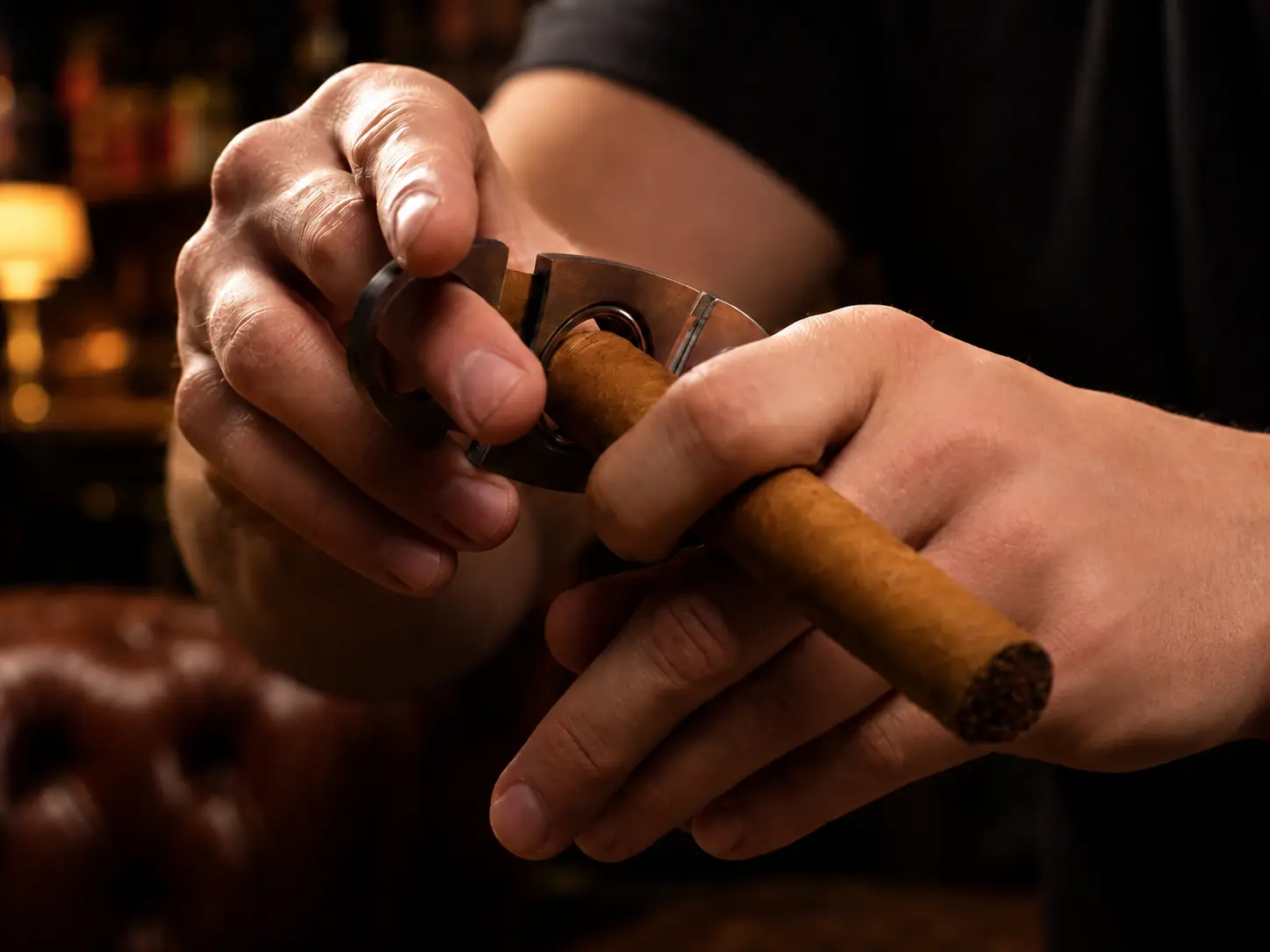
ROBUSTO TORO CHURCHILL CORONA GORDO TORPEDO BOX-PRESSEDHold the cigar firmly but not tight enough to dent the wrapper. Find the shoulder, that curve where the rounded head meets the straight body. Place the cap into the guillotine cutter just above that shoulder, and cut with one quick, confident motion. Don't saw at it. Don't nibble. Line it up, commit, and slice.
The Table Trick
Here's one of the cleanest pro tips I know for a consistently perfect guillotine cut. Lay the cutter flat on the table. Open the blades. Place the head of the cigar into the opening so the cap rests naturally against the flat surface, then close the cutter. The table limits how far the cigar passes through, which means you're physically prevented from cutting too deep. Simple, elegant, and a lifesaver for anyone who tends to go too far. Works especially well for newer smokers still developing their feel for depth.
Single Blade vs. Double Blade
A single guillotine uses one blade. It can work fine when sharp, but a dull single blade will push the cigar sideways before cutting through, which can crush or tear the wrapper. For best results, place the cigar on the far side of the opening and pull the blade through in one fluid stroke.
A double guillotine uses two opposing blades that move toward each other simultaneously. Because the pressure comes from both sides evenly, the cut is typically cleaner and more precise. Most experienced smokers gravitate toward double-blade cutters for this reason. Both work, but a double blade is more forgiving if your technique isn't perfect yet.
Method 2: Cigar Scissors
Cigar Scissors
Cigar scissors produce a straight cut just like a guillotine, but they give you exceptional visual control. You can see exactly where the blades are landing, which makes it easy to judge depth with precision. Open the scissors, position the blades just above the shoulder, and clip with a steady, deliberate motion.
Best for:
PAREJO SHAPES SLOWER RITUAL SMOKERS HOME & LOUNGE USEThe upside of scissors is complete visual control, you see the cut before it happens. The downside is that cheap or dull scissors will crush the cap rather than slice it cleanly. If you're going scissors, invest in a quality pair built specifically for cigars. They're not always the most portable option, but they look good, feel substantial in the hand, and when sharp, produce a beautiful clean cut every time.
Method 3: The V-Cut (Wedge Cut)
The V-Cut
Instead of slicing across the full cap, the V-cutter removes a wedge-shaped notch from the center of the head. You place the cigar into the cutter, press down, and the blade cuts a V-shaped channel into the cap. This creates a more focused draw pathway, tighter than a full straight cut, but more open than a punch.
Best for:
ROBUSTO TORO CHURCHILL LARGE RING GAUGE BOX-PRESSEDThe V-cut, also called a wedge cut or cat's eye cut because of the slit it leaves in the cap, concentrates the smoke pathway. Many smokers find it intensifies flavor on the palate. It also leaves more of the cap structure intact than a straight cut, which can reduce loose tobacco in your mouth. Some people love it. Others find the focused draw burns the cigar slightly hotter. It's one of those things you just have to try for yourself.
Where it shines: larger ring gauge cigars (54+) where a full straight cut creates a very wide, sometimes sloppy opening. The V-cut keeps it controlled. Where it struggles: small ring gauge cigars under 42, where there simply isn't enough cap surface to create a clean wedge. Also avoid cheap V-cutters, a dull V-blade will crush before it cuts.
Method 4: The Punch Cut
The Punch Cut
A punch cut uses a small cylindrical blade to remove a round plug from the center of the cap. You press the punch against the head, give it a gentle twist, and pull out the small tobacco plug. What you're left with is a circular opening rather than a full cut across the head.
Best for:
STANDARD PAREJOS ROBUSTO TORO ROUNDED CAPSPunch cuts are portable, many punch cutters clip onto a keychain as a bullet-shaped tool, which is how you'll sometimes hear them called "bullet cutters." They keep more of the cap intact, which means fewer loose bits of tobacco in your mouth. The flavor can also feel slightly more concentrated, since smoke passes through a smaller opening.
The big punch mistake: going too deep. You are not drilling for oil. Press the punch gently into the cap, give it one clean twist, and pull the plug. That's it. If you push too far, you compact the filler tobacco, which tightens the draw and can create buildup issues. Press, twist, remove the plug, test the draw.
Where punch cuts don't work: torpedoes, belicosos, perfectos, and any cigar with a tapered or pointed head. There's no flat surface to grip. Don't try to make it work on a figurado, reach for a straight cutter instead.
Method 5: The Piercing Method
Piercing is old-school. Instead of removing cap material, you use a cigar piercer or pointed needle to make one or more small holes directly through the cap. The most common version is the three-hole pierce, where three small holes are made in a triangle pattern to create distributed airflow without removing any material.
Honestly? It's functional, but it's at the bottom of my list. Piercing tends to create a tight, restricted draw. As the cigar warms up, moisture and tar tend to concentrate around those small holes, which affects flavor. If you have a draw issue or you're working with a cigar that's constructed a little tight, a punch is almost always a better option. Piercing is niche. Worth knowing, but not where I'd send a newcomer first.
Method 6: The Bite Cut (Last Resort)
Let's be honest. It happens. You've got a great cigar, you're somewhere beautiful, and you don't have a cutter. You look around like MacGyver surveying a campsite. And then you bite it.
If there's truly no cutter available, here's how to do the least damage. Place the cap gently between your teeth, front teeth for control. Rotate the cigar slowly. Use light, even pressure. Let the cap break rather than forcing it. Spit out the loose tobacco. Clean up the edge as best you can with a fingernail or blade of grass if you're really roughing it.
It's going to be rough. Loose tobacco is coming. But if the alternative is not smoking the cigar at all, it gets the job done. That said, a small punch on your keychain or a backup guillotine in your travel bag costs almost nothing and eliminates the need for dental improvisation entirely.
Quick Reference: Cut by Cigar Shape
| Cigar Shape | Recommended Cut | Why It Works |
|---|---|---|
| Robusto | Straight or V-cut | Both work well. Straight for an open draw; V-cut for a more focused, concentrated smoke path. |
| Toro | Straight or V-cut | Enough cap surface for either method. A personal preference call. |
| Churchill | Straight cut | Longer cigars benefit from a clean, open draw for consistent burn over the full smoke. |
| Corona | Straight cut | Smaller ring gauge works best with a precise straight cut. V-cuts can be too aggressive here. |
| Gordo / Large Ring | V-cut, punch, or straight | Larger cigars support different cuts. Avoid an overly large or sloppy straight cut, keep it controlled. |
| Box-Pressed | Straight or V-cut | Both work. Make sure the cutter sits evenly on the flat cap surface. |
| Torpedo | Straight cut | Cut gradually from the tip, a little at a time, until the draw feels right. Small cuts matter here. |
| Belicoso | Straight cut | The tapered head gives you room to adjust. Cut conservatively and test before going further. |
| Perfecto | Straight cut | Start small. With any shaped cigar, you can always cut more, you can't put it back. |
| Small Ring Gauge (<42) | Straight cut | V-cuts and punches are often too aggressive or awkward on small cigars. Straight cut only. |
Common Cutting Mistakes
MISTAKES WORTH AVOIDING
This is the big one. The shoulder holds the wrapper in place. Cut into it and you're asking for the cigar to unravel, which ruins the structural integrity and ruins the smoke.
A dull blade crushes before it cuts. That compression can split the wrapper and damage the cap. A sharp cutter slices cleanly. Replace or sharpen your cutter regularly, it makes more difference than most smokers realize.
Hesitation is the enemy. A slow, tentative cut tears the cap rather than slicing it. Line it up, commit, and execute in one confident motion. Cut like you mean it.
You're opening the cap, not boring through the filler. Press, twist, remove the plug, and stop. Going too deep compacts the tobacco and tightens the draw.
A punch on a torpedo. A deep V-cut on a small ring gauge. Matching the tool to the cigar shape isn't optional, it's the whole game.
If you've already cut too deep, taking more off rarely solves anything. Slow down, moisten the wrapper gently if it's starting to peel, and smoke what you've got. Sometimes the best move is acceptance.
Cutting Glossary
| Term | Definition |
|---|---|
| Guillotine Cut | The classic straight cut across the cap of the cigar. Works on most standard cigar shapes and delivers an open, consistent draw. |
| Single Guillotine | A cutter with one moving blade. Effective when sharp, but a dull single blade may crush or torque the cap before cutting through. |
| Double Guillotine | A cutter with two opposing blades. Cuts from both sides simultaneously for a cleaner, more even slice. |
| Straight Cut | Any flat cut across the head of the cigar, whether made by guillotine or scissors. |
| V-Cut | A wedge-shaped notch cut from the cap using a V-shaped blade. Creates a focused, concentrated draw. |
| Wedge Cut | Another name for the V-cut. The cutter creates a channel in the cap rather than removing the full top layer. |
| Cat's Eye Cut | An older name for the V-cut, referencing the narrow slit shape left in the cap after cutting. |
| Punch Cut | A small circular blade removes a round plug from the cap. Portable, clean, and reduces loose tobacco in the mouth. |
| Plug Cut | Another term for the punch cut, named for the circular plug of tobacco removed from the cap. |
| Bullet Cutter | A compact punch cutter shaped like a bullet or keychain tool. Common for on-the-go smokers. |
| Piercing | Opening the cigar by making small holes through the cap rather than removing material. |
| Three-Hole Pierce | A piercing method using three holes in a triangle pattern for distributed airflow. |
| Cigar Scissors | Purpose-built scissors designed to cut the cap cleanly. Excellent control, best when sharp. |
| Bite Cut | Opening the cigar by biting through the cap. Last-resort only. Messy, inconsistent, but it works in a pinch. |
| Field Cut | Any improvised cut made without a proper cutter, knife, matchstick, fingernail, or teeth. |
| Cap | The small piece of wrapper leaf affixed to the head to close and seal the cigar. This is what you open before smoking. |
| Shoulder | The curved transition point between the rounded head and the straight body of the cigar. The line you never cut past. |
Frequently Asked Questions
The questions we hear most, answered straight.