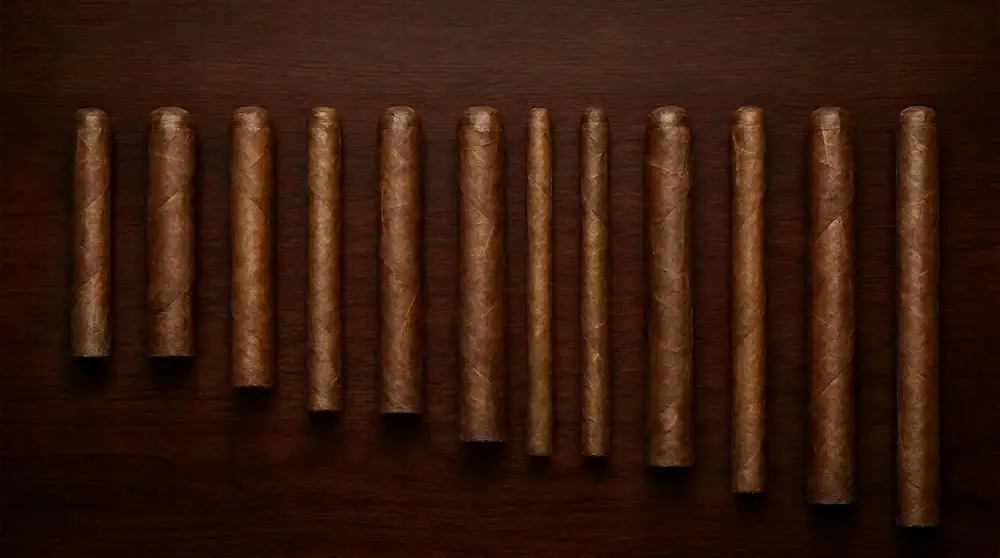
A cigar's vitola, its size and shape, changes far more than appearance. It changes how the blend burns, how the smoke feels on the palate, how quickly strength builds, how much influence the wrapper has, and how long the cigar gives you to experience its transitions. That is why the same blend can feel sharp, refined, and wrapper-driven in one format, then broad, cooler, and more filler-led in another.
- Vitola means a cigar's size and shape, and it has a real impact on flavor, burn, draw, smoking time, and overall feel.
- Smaller ring gauges, like a lancero, put more emphasis on the wrapper and often deliver a more focused, concentrated version of a blend. Larger ring gauges, like a gordo, burn cooler and slower, carry more filler, and usually present the blend in a rounder, smoother, more forgiving way.
- Bigger does not automatically mean stronger, and smaller does not automatically mean better. If you want to truly understand a cigar line, smoke it in more than one size.
Early on, I didn't think vitola would matter that much. I brought home a variety of sizes from the same line and expected more or less the same cigar in a different format. Then I started lighting them up and realized one of them clearly had more flavor. The burn was different. The draw was different. The strength felt different. Even the way the blend sat on my palate was different.
That was the moment it clicked. A cigar is not just tobacco wrapped in a different diameter. The size changes the experience. Since then, I've gone out of my way to buy multiple vitolas from the same line, because they really are different smokes. A lancero and a gordo from the same brand are not duplicates. They are different expressions of the same blend, and once you understand why, it changes how you shop, how you smoke, and how you judge a cigar.
WHAT A VITOLA ACTUALLY IS
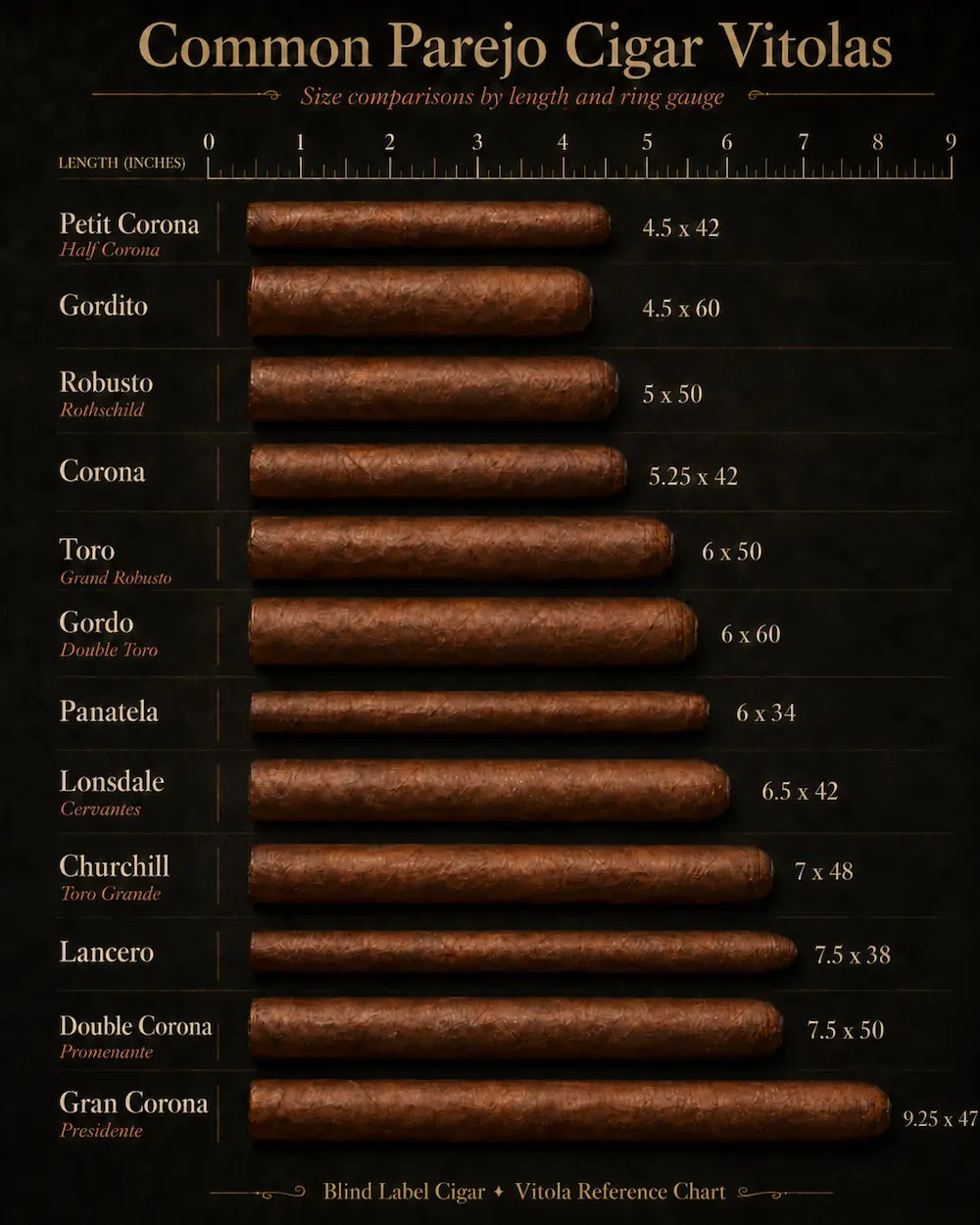
Vitola is the term used for a cigar's size and shape. At its most basic, that means length and ring gauge. Length is measured in inches. Ring gauge is the cigar's diameter, measured in 64ths of an inch, so a 64 ring gauge cigar is exactly one inch wide, while a 38 ring gauge lancero is considerably slimmer and more refined in the hand.
That may sound technical, but in practice it's simple. A vitola tells you how the cigar is built, and that construction directly affects the smoking experience. Two cigars can share the same wrapper, binder, and filler blend, but if one is a 7½ x 38 lancero and the other is a 6 x 60 gordo, they are not going to smoke the same way. Not even close.
There are two broad families. The parejo is the standard straight-sided cigar most people know, robusto, toro, corona, Churchill, lancero, gordo. The figurado includes anything that departs from that straight profile: torpedo, belicoso, perfecto, pyramid, salomon. Those shapes are not just aesthetic. The taper changes how the smoke moves, how the draw feels, and how flavors build as the ember works through changing widths.
If you want the short version: vitola is architecture. And in cigars, architecture matters.
COMMON CIGAR VITOLAS AT A GLANCE
This is not an exhaustive list, the cigar world has dozens of named sizes, but these are the ones you will encounter most often, and the ones worth understanding before anything else.
| VITOLA | TYPICAL DIMENSIONS | SESSION TIME | FLAVOR EMPHASIS |
|---|---|---|---|
| Half Corona | 3.5 × 42 to 4 × 44 | 20–30 min | Quick, concentrated, often sharper and more direct |
| Petit Corona | 4.5 × 40 to 42 | 30–40 min | Balanced but wrapper-leaning, excellent for shorter sessions |
| Corona | 5.5 × 42 to 44 | 40–55 min | Classic benchmark, balanced wrapper and filler expression |
| Corona Gorda | 5.5–6 × 46 to 48 | 50–65 min | Slightly fuller than a corona, often a sweet spot for complexity |
| Robusto | 4.75–5.5 × 48 to 52 | 45–60 min | Rich, direct, balanced, one of the easiest vitolas to judge a blend in |
| Toro | 6 × 50 to 52 | 60–75 min | More gradual development, cooler early burn, fuller transition |
| Churchill | 7 × 47 to 50 | 75–90 min | Long, evolving, often refined early and richer late |
| Double Corona | 7.5–8.5 × 49 to 52 | 90–120 min | Expansive, slow-building, designed for long transitions |
| Lancero | 7–7.5 × 38 to 40 | 50–75 min | Highly focused, wrapper-driven, concentrated flavor, less forgiving |
| Lonsdale | 6.5 × 42 | 60–75 min | Refined and balanced, a graceful middle ground |
| Gordo | 6 × 60 | 80–100 min | Cooler, slower, filler-led, smooth and forgiving |
| Torpedo | 6–6.5 × 50 to 54 | 60–80 min | Focused draw, concentrated smoke, more pointed on the palate |
| Belicoso | 5–5.5 × 50 | 50–70 min | Similar to torpedo but softer, often more approachable |
| Pyramid | 6–7 × 40 to 52+ | 70–90 min | Changes in concentration as ring gauge widens through the smoke |
| Perfecto | 4.5–6.5 × variable, tapered both ends | 45–75 min | Dynamic profile, wrapper-forward early, fuller mid-smoke |
| Salomon / Diadema | 7–8.5 × variable, often 50 to 58+ at widest | 90–120+ min | Complex, evolving, dramatic changes in draw and flavor |
WHY THE SAME BLEND TASTES DIFFERENT IN DIFFERENT SIZES
This is where the lightbulb moment usually happens.
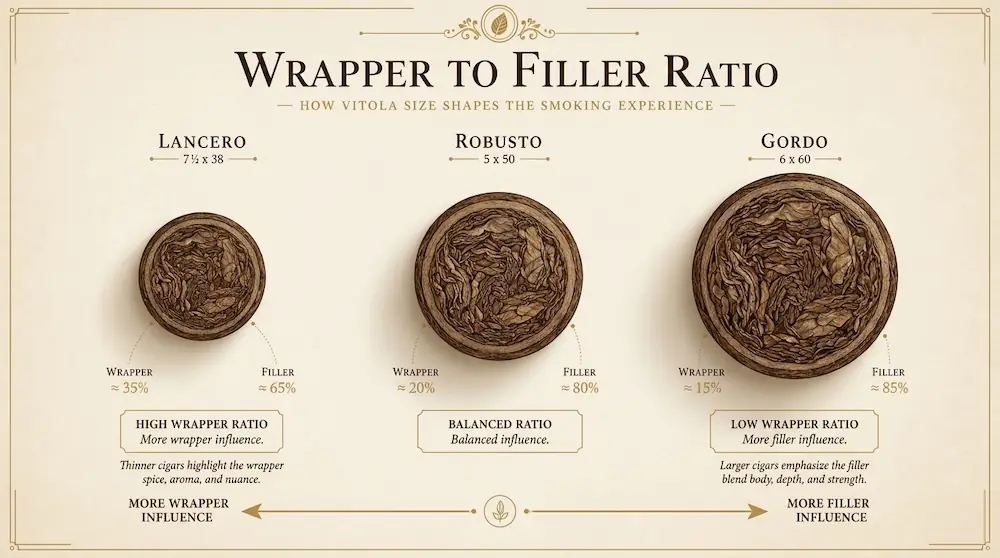
The reason vitolas matter comes down to geometry, combustion, and proportion. As a cigar gets wider, the amount of filler inside increases much faster than the amount of wrapper covering it. That means a thinner cigar delivers more wrapper influence relative to the filler. A wider cigar gives the filler more room to speak.
That's why a lancero often feels more focused and expressive. The smaller circumference means the wrapper plays a bigger role in what you taste. If the wrapper is spicy, sweet, earthy, or floral, you're more likely to notice it clearly in a narrower vitola. The blend feels more concentrated, more defined, and sometimes more intense.
A gordo works differently. It carries a lot more filler, which means the wrapper's role is reduced in proportion. The smoke tends to feel rounder, cooler, and more blended. You may lose some of the sharp detail you get from a lancero, but you gain body, smoke volume, and a more relaxed, forgiving burn. In a good gordo, the filler blend becomes the main event.
THE LANCERO AND THE GORDO: TWO EXTREMES WORTH UNDERSTANDING
The Lancero
The lancero has a cult following for a reason. Long and slim, usually around 7 to 7½ inches with a ring gauge around 38, that narrow profile gives the wrapper more authority in the smoke. When the wrapper is excellent, the result can be beautiful. You get clarity. Spice feels sharper. Sweetness feels cleaner. Earth, cedar, leather, or cocoa notes often come through with more precision than you'd get anywhere else in the same line.
But there's a catch. A lancero asks more of the roller and more of the smoker. Construction has to be spot on, there's less room for error in a narrow format. On the smoker's side, a lancero rewards patience. Puff too quickly and it heats up, sharpens too far, and loses its balance. Smoke it slowly and it can be one of the most revealing formats in the humidor.
GETTING THE MOST FROM A LANCERO
- Slow down your cadence. One draw every 45–60 seconds is not too slow for a lancero. The narrower format heats up faster than a robusto.
- Check construction before you buy. Gently squeeze the length. Any hard or soft spots in a narrow format will show immediately in the smoke.
- Let it rest after lighting. Give the lancero 30–45 seconds to settle before your first serious draw. It rewards patience from the very first puff.
- Pair with something subtle. A strong, assertive drink can overpower the precision a lancero offers. Let the wrapper speak.
The Gordo
The gordo sits on the other end of the spectrum. Usually around 6 x 60, sometimes larger, it gives a very different ride. That larger diameter carries a much bigger filler core, which helps the cigar burn cooler and more slowly, and makes it more forgiving for smokers who tend to draw a little fast.
The result is often a smoother, broader smoke with a lot of mouthfeel and output. A good gordo can be deeply satisfying because it feels substantial. It gives the blender room to work with multiple filler leaves and build complexity from the inside out. What it usually doesn't do is highlight the wrapper with the same precision as a lancero or corona, and that's simply the nature of the format.
LENGTH, PAREJOS, AND FIGURADOS
Why Length Matters
Ring gauge gets most of the attention, but length matters as well. A longer cigar gives the smoke more distance to travel before it reaches your palate, that extra runway can make the opening feel cooler and more measured, and it gives the blend more time to evolve before the final third arrives.
That's one reason a toro often feels more gradual and composed than a robusto. It's not just more cigar. It's more time for the blend to open up. A Churchill takes that even further, in the early stages it can feel refined and controlled, then gradually deepen as the ember works its way down. A shorter cigar, especially in a stout ring gauge, tends to get to the point faster. That's part of the robusto's appeal: it doesn't waste time.
Parejos vs. Figurados
Most smokers live in parejo territory without realizing it. Straight-sided cigars dominate the market because they're consistent, familiar, and easier to compare across brands. Robusto, toro, corona, lancero, Churchill, gordo, all parejos.
Figurados are more theatrical, but that doesn't make them gimmicks. A torpedo concentrates the smoke differently than a straight parejo. A perfecto changes character as it burns, the cigar widens and narrows across the smoke, so you're not just smoking tobacco, you're smoking through changing geometry. A torpedo even lets you influence the experience through your cut: take less off and you get a more focused draw; cut more and it opens up considerably.

STRENGTH IS NOT THE SAME THING AS SIZE
This is one of the most persistent beginner misunderstandings in cigars. A bigger cigar is not automatically stronger. A longer cigar is not automatically fuller. Strength comes from the tobacco itself, specifically the primings used in the filler. Ligero, grown higher on the plant, tends to be stronger and slower burning. Seco is lighter and more aromatic. Viso sits in between.
A small cigar packed with strong ligero-heavy filler can hit much harder than a large cigar made with milder leaf. What size changes is not the strength of the leaf itself, but how the blend is delivered. A thin cigar can feel more intense because the wrapper is more present and the burn can run hotter. A larger cigar can feel smoother because of added filler mass and cooler combustion. That is perception and presentation, not raw nicotine strength.
THE CORE VITOLAS EVERY SMOKER SHOULD UNDERSTAND
If you want to build real knowledge about cigars, there are a handful of vitolas worth knowing well before anything else.
The corona is the old reference point, around 5½ inches by 42 ring gauge. It's long been one of the classic formats for tasting a blend in balanced form. Many serious smokers still consider it one of the purest ways to judge a cigar. The robusto became the modern workhorse for a reason: compact, flavorful, practical, and forgiving enough for both beginners and veterans. The toro adds length while keeping a comfortable ring gauge, and for many smokers represents the sweet spot between smoking time and flavor development.
The Churchill is for moments when time is not the enemy, a slower, more deliberate progression that often becomes richer as it goes. The lancero is the specialist: precise, wrapper-driven, and unforgiving of poor construction. And the gordo represents the modern appetite for long, cool, easy-burning formats that let the filler blend carry the session.
HOW TO CHOOSE THE RIGHT VITOLA FOR THE MOMENT
- New to a blend? Start with a robusto or toro. Balanced, widely available, and forgiving enough to focus on flavor rather than fighting the cigar.
- Want to understand the wrapper? Try a corona or lancero. The narrower format amplifies wrapper character more than any other size.
- Want a cool, relaxed long session? Reach for a gordo. The filler drives the experience and the burn stays measured the whole way down.
- Match the vitola to the time you have. Don't light a Churchill with 30 minutes on the clock. Don't rush a double corona. Smoking time is part of the experience.
- The real education: buy the same line in three sizes. Same humidor, same beverage, same time of day. That exercise will teach you more than any conversation at the cigar shop.
GLOSSARY
| TERM | DEFINITION |
|---|---|
| Vitola | The size and shape of a cigar, usually defined by its length and ring gauge. |
| Ring Gauge | The diameter of a cigar measured in 64ths of an inch. |
| Parejo | A straight-sided cigar shape with a rounded cap and open foot, the most common format on the market. |
| Figurado | Any cigar that departs from a straight-sided shape, such as a torpedo, belicoso, perfecto, or salomon. |
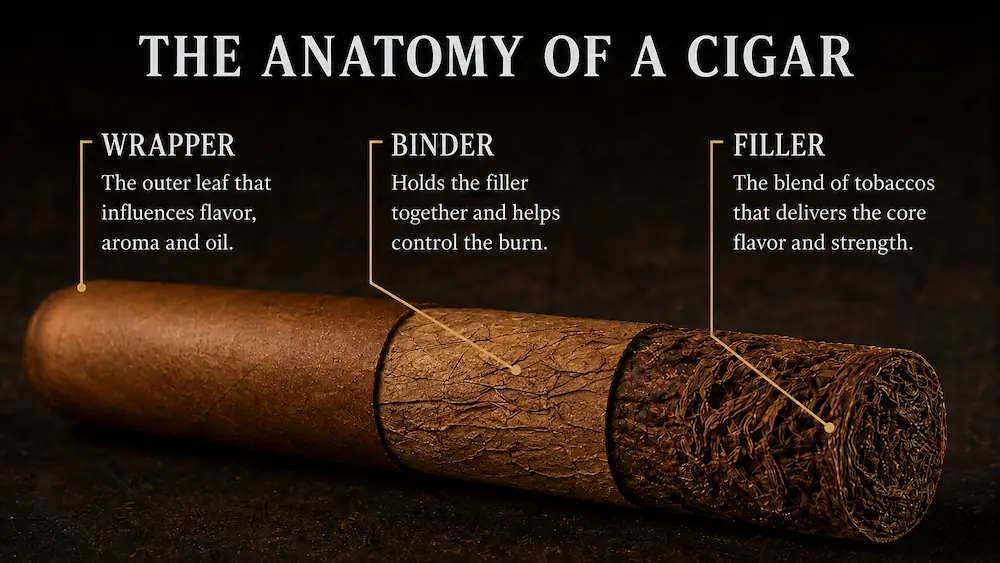
| Wrapper | The outer leaf of the cigar. It plays a major role in flavor, aroma, and combustion. |
| Binder | The leaf beneath the wrapper that holds the filler together. |
| Filler | The internal blend of tobacco leaves that makes up the body of the cigar. |
| Ligero | Stronger tobacco from higher on the plant, often used to add body and strength. |
| Seco | Lighter tobacco with more aroma and less power. |
| Viso | A middle-ground tobacco used to balance strength, aroma, and combustion. |
| Vitola de Galera | The factory name for a cigar size and shape. |
| Vitola de Salida | The market or commercial name used for consumers. |
FREQUENTLY ASKED QUESTIONS
The most common questions about vitolas, sizes, and shapes.