

Walk into a humidor and the air hits you, cedar, earth, and the faint sweetness of perfectly conditioned tobacco. This article covers the nine most common walk-in humidor etiquette mistakes, from over-squeezing and nose-hogging to pillaging limited allocations, wearing fragrance, and bringing in a lit cigar. Each one comes with the reasoning behind the rule and a practical fix, because humidor etiquette isn't about rules for rules' sake, it's about respecting the product, the tobacconist, and every smoker who comes after you.
- Cigars are not produce. One light press between thumb and forefinger is the limit, anything more damages product that isn't yours yet.
- The tobacconist is the curator of a living inventory that took months to source and condition. Respect the space, the pricing, and the craft behind it.
- Nine mistakes separate the aficionados from the amateurs. Master them and the shop remembers your name fondly. Break them and you become the story they tell other customers.
1. THE OVER-SQUEEZER (DON'T CRUSH THE CIGAR)
Cigars are not tomatoes at the grocery store. They are not grapefruits that need the squeeze test. The thin wrapper leaf, often grown under shade, fermented for months, and selected by hand, is extraordinarily delicate. Over-handling creates micro-cracks in the wrapper that unravel mid-smoke and ruin the draw. The oils in the leaf that give your cigar its character are right there at the surface, and rough handling bruises them before you've ever struck a flame.
Gently press the cigar between thumb and forefinger if you must, once, lightly. Feel slightly spongy? That's proper humidity. Rock-hard or brittle means it's dried out and you should pass. Anything beyond that single, light test and you are damaging someone else's purchase. Roll it between your palms and you can cause a cracked cap before the cigar ever leaves the box.
See with your eyes, touch with restraint. A quality humidor at 65–70% RH looks like it feels, cigars will have a slight sheen and uniform color. If you're genuinely concerned about humidity, ask the tobacconist. That's what they're there for.

2. THE NOSE HOG (STOP SNIFFING EVERY CIGAR)
The humidor smells incredible. Cedar walls, aged tobacco, a hint of earth and sweetness, that's the point. The ambient aroma of a well-maintained walk-in is one of the best things about being in one. But that doesn't mean you need to shove every cigar under your nose like a wine cork at a tasting.
Here's the problem: your breath carries moisture, bacteria, and whatever you had for lunch. When you breathe directly on the foot of a cigar, especially in a high-humidity environment, you're contaminating the wrapper for the next person. Worse, in a room running 68–70% relative humidity, you can actually trigger mold growth on the foot of the cigar by pressing it to your face. The wrapper is porous. It absorbs. What goes on it stays on it.
And beyond the hygiene issue, there's just the basic reality that picking up every cigar in a box to smell it handles them unnecessarily. Every pick-up is a risk of dropped cigars, cap damage, or wrapper cracks.
Enjoy the ambient aroma, it tells you plenty. If a specific cigar genuinely intrigues you, ask the tobacconist to pull one from the back for a proper look. They'll often cut one for you to cold-draw before you commit. That's the right move.

3. THE PILLAGE PARTY (LEAVE SOME FOR THE NEXT GUY)
You spot that hard-to-find allocation sitting right there on the shelf. Pepin Garcia's latest. An OpusX release. A Davidoff limited you've been chasing for weeks. Your eyes light up. You grab every single one in the box and walk straight to the register.
Congratulations, you just pillaged the humidor. Every customer who walks in over the next week will see an empty box and assume the shop is poorly stocked. The shop's reputation takes the hit, not yours. And tobacconists notice this behavior with absolute clarity. They remember who cleaned out the shelf. They remember it when the next allocation comes in. They remember it when you walk back in six months later looking for something they just happen to have in the back.
The premium cigar community is smaller than it looks. Retailers talk to each other. Regulars talk to each other. Reputation travels.
Take what you need for personal use, a box, maybe two if it's something truly exceptional and you have a real relationship with the shop. If it's a limited release, leave some for the next smoker. The shop will restock. Your standing as a considerate, loyal customer outlasts any single cigar on that shelf.

4. THE LIT CIGAR STALKER (NO SMOKING INSIDE)
You're halfway through a beautiful Nicaraguan, the ember's going strong, and you decide it's a good time to duck into the humidor and grab your next stick. It seems harmless. It is not.
Walk-in humidors are precision environments. The temperature sits between 65 and 70 degrees Fahrenheit. Relative humidity is dialed to somewhere between 65 and 72 percent. That balance takes days to stabilize after any disruption. Your lit cigar introduces combustion byproducts, carbon monoxide, particulate matter, ash residue, and tar vapor, directly into that controlled atmosphere. Those particles don't disappear. They settle. On the cedar. On the boxes. On the wrapper leaves of every cigar in the room. The next person who buys that stick gets a subtle ghost of your smoke before they've even cut it.
Beyond contamination, an open flame in a humidity-controlled space with thousands of dollars of inventory is exactly the kind of thing that gets you asked to leave and never come back.
Set the cigar down in an ashtray in the lounge, or let it rest outside. Make your selection, pay, and light up after. If you're between sticks and want to browse for your next one, that's fine, just do it without the burning tobacco in your hand.

5. THE LOUD COMPLAINER (PRICE IS THE PRICE)
"These are way cheaper at the duty-free in Cancún." "I got this same box for half the price online." "I don't know how you stay in business charging that." The tobacconist has heard every variation. Every single day.
Here's what they're not saying back to you: their rent is real. Their humidity control system runs around the clock, every day of the year. Their staff has knowledge that took years to build. The cigars on those shelves were sourced, shipped, and conditioned with care that no online discount retailer matches. And the walk-in humidor you're standing in, that environment you're enjoying right now, costs money to maintain.
Price-shopping out loud in someone else's shop is bad manners anywhere. In a cigar lounge, where the tobacconist is often the owner and the staff are passionate enthusiasts, it's genuinely insulting. You wouldn't walk into a great restaurant and tell the chef you can get a similar steak cheaper at the grocery store. Same energy.
If the price doesn't work for your budget, that's completely fair. Thank them genuinely, tell them you'll think about it, and shop elsewhere without the commentary. Come back when you find a cigar worth the price, and you will. A gracious exit costs you nothing and keeps the door open.

6. THE CUBAN SUPREMACIST (OPEN YOUR MIND)
"I only smoke Cubans." "Everything else tastes like a cigarette to me." "Non-Cubans are fine for beginners." Every tobacconist in every quality shop in North America has heard this speech. It doesn't make you sound experienced. It makes you sound like someone who stopped paying attention fifteen years ago.
Cuban cigars are genuinely legendary. The Vuelta Abajo region produces tobacco that has no direct equal, the combination of soil, climate, and centuries of cultivation creates a flavor profile that's unmistakably Cuban. Nobody serious is denying that. But the idea that everything grown outside of Cuba is categorically inferior is simply not supported by what's actually being produced right now.
Nicaragua has emerged as arguably the most exciting tobacco-growing region in the world. The Jalapa and Estelí valleys produce leaf with a complexity, pepper, and depth that regularly outscores Cuban product in blind tastings. The Oliva Serie V, the Padrón 1926, the Liga Privada No. 9, these are world-class cigars by any standard. The Dominican Republic has been producing refined, nuanced blends for decades. Honduras grows some of the richest, earthiest leaf on the planet. Ecuador and Connecticut shade-grown wrappers finish blends that Cuban tobacco alone can't achieve.
Dismissing 95% of the humidor because of a flag on the band doesn't make you a connoisseur. It makes you the person who orders the same thing off every menu because they're afraid of being wrong.
Tell the tobacconist your flavor profile, earthy, spicy, creamy, medium-bodied, full, and let them make a recommendation. If you genuinely prefer Cubans after an honest comparison, great. But give the comparison an honest shot. Your next favorite cigar might not have a single gram of Cuban leaf in it.

7. THE BOX DIGGER (DON'T REARRANGE THE HUMIDOR)
Walk-in humidors are organized systems. Brands grouped together. Strength levels running light to full across the shelves. Limited releases in their own section. Event cigars near the register. The staff spent real time building that layout so customers can navigate it intuitively, and so they can find a specific cigar in thirty seconds when you ask for it.
The box digger ignores all of that. They pull boxes off shelves, rifle through them like a clearance bin, check under other boxes, pull three cigars out to examine them, slide one back into the wrong spot, leave a box half-open. In a humidity-controlled room, an open box loses moisture faster than a closed one. Cigars left loose on the cedar need to be repositioned. The whole section has to be reset before the next customer comes in.
Every cigar you pick up and don't buy is a handling event. A risk of a dropped wrapper. A possible cap crack from being set down too quickly. A fingerprint on the foot. The casual digger causes more damage per visit than any single bad customer, because they spread it across every box they touch.
Ask the staff before you start digging. Tell them what you're looking for, brand, strength, size, price range, and let them pull it. They know the inventory better than you do and can save you twenty minutes of searching. If they're busy, take a lap and look before you touch. The cigar you want is either there or it's not.
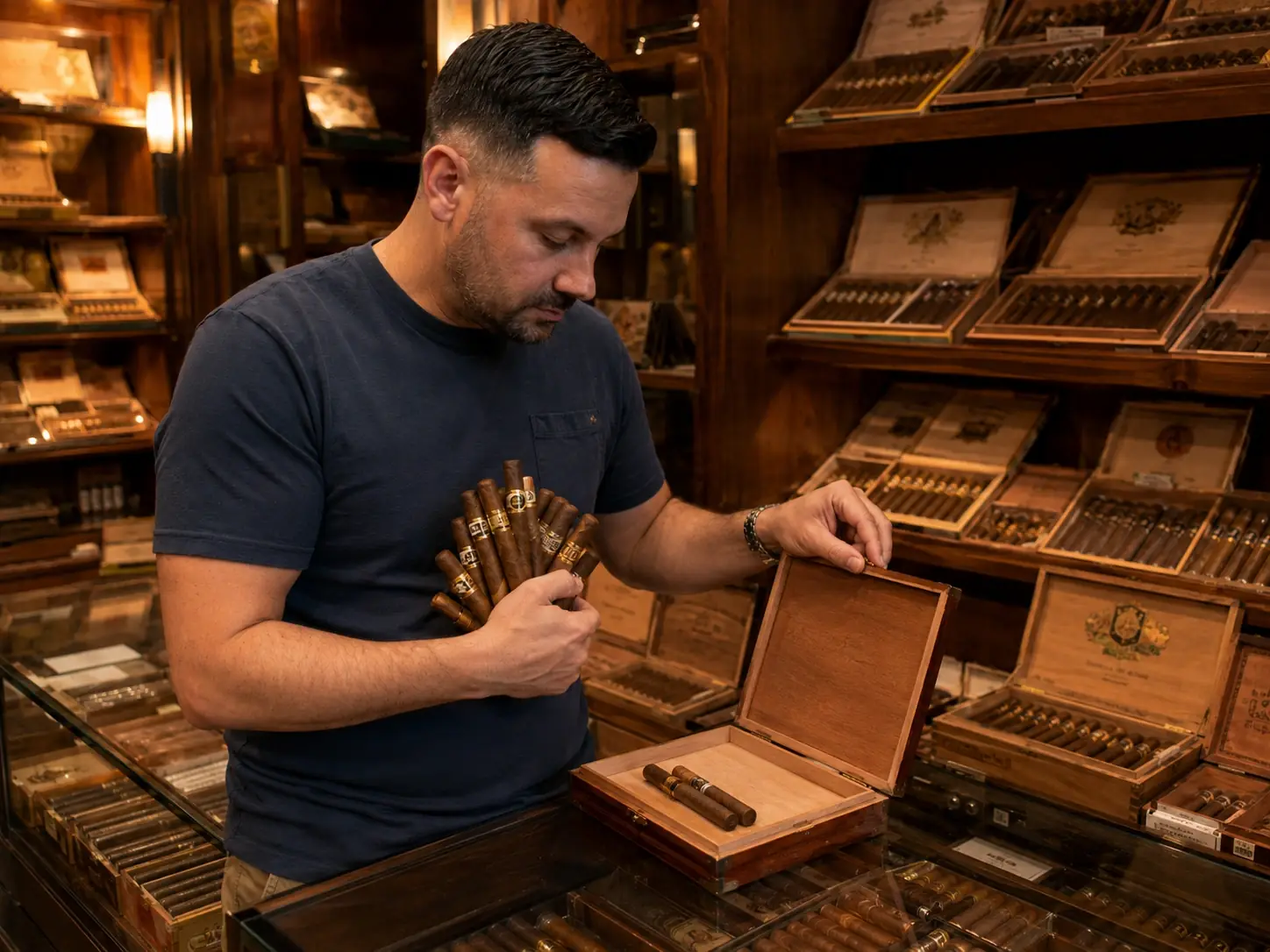
8. THE FRAGRANCE BOMBER (NO PERFUME OR COLOGNE)
This one catches people off guard because it doesn't feel like disruptive behavior. You got dressed, you put on your usual cologne, and you walked into the humidor to pick something up. What's the problem?
The problem is the wrapper. Tobacco leaf is extraordinarily porous, it's one of the properties that makes it capable of fermentation and aging in the first place. That porousness means it absorbs aromas from its environment, which is why humidors are lined with Spanish cedar rather than pine or generic hardwood. Cedar's subtle aroma complements aged tobacco. Your Dior Sauvage does not.
When you move through a humidor wearing strong fragrance, you're depositing scent molecules on every wrapper surface you pass near. Not just the cigars you handle, every cigar within range. The person who buys the Padron Añiversario from the box next to where you were standing is going to get a faint ghost of your cologne in their first few puffs. They'll think the cigar is off. They might complain to the shop. The shop has no idea it was you from Tuesday.
The same principle applies to cigar lounges. Sitting next to someone who's wearing heavy fragrance while trying to evaluate a $30 stick is genuinely unpleasant. The aromatic environment is part of the experience. Don't corrupt it.
Skip the cologne and perfume on days you're visiting a cigar shop or lounge. If that's not realistic, use something light and neutral, and apply it early enough that it's largely dissipated by the time you arrive. Unscented deodorant is always the right call. Your fellow smokers will thank you, even if they never know why.

9. THE IGNORANT ASKER (DO YOUR HOMEWORK)
"Do you have any good cigars?" is not a question. It's a signal, to the tobacconist, to anyone within earshot, that you haven't thought about what you actually want. Good tobacconists will work with it because it's their job. But "good" is a useless variable. Every cigar in a quality humidor is good. That's why it's there.
The tobacconist needs information to help you. Not an encyclopedia, just a few coordinates. What strength range you're comfortable with. How long you want to smoke. What you've enjoyed before, even roughly. Whether you prefer earthy, spicy, creamy, or sweet profiles. Your budget. Any one of those data points gets them to a meaningful recommendation in seconds. Without any of them, they're guessing, and the cigar they hand you may be totally wrong for you.
This isn't about knowing the difference between a Seco and a Ligero before you walk in. It's about being a self-aware consumer. You're about to spend anywhere from $10 to $60 on a cigar you're going to spend the next hour with. A little preparation makes that investment work much harder.
Walk in with three things: a strength preference (mild, medium, or full), a rough idea of how long you want to smoke (30 minutes, an hour, two hours), and a budget. That's it. Hand those three things to the tobacconist and let them do what they're good at. You'll get a better cigar and a much better conversation.
, NORM FARRAR · BLC
THE BLIND LABEL TAKE
Humidor etiquette is simple: treat the cigars, the space, and the people with the same respect you'd expect for your own collection. The tobacconist is not your servant. They are the curator of a living inventory that took months to source, condition, and organize. Act like you belong there, and they'll treat you like you do.
Master these nine standards and you'll be the customer every shop remembers fondly, the one who gets the call when something exceptional comes in, who gets steered toward the good stuff before it hits the shelf, who becomes part of the culture rather than just a transaction in it. Break them, and you'll be the story they tell other smokers over a smoke at the end of the day. The choice is yours.
Frequently Asked Questions
Common questions about walk-in humidor etiquette.