
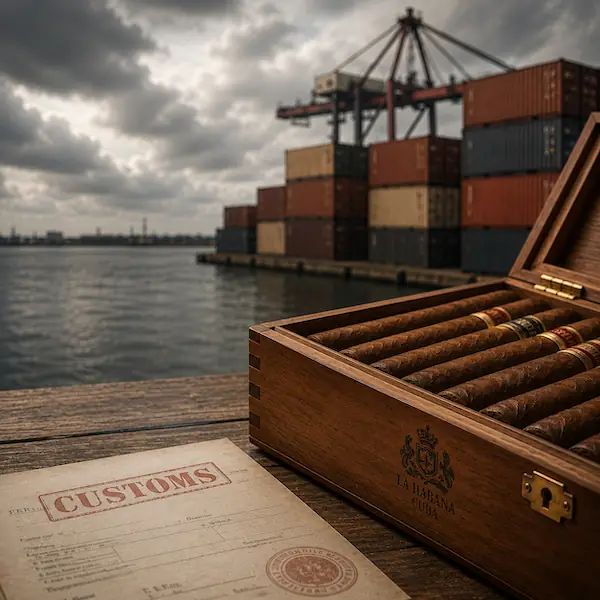
If you’ve been following the news over the past year, you already know that trade policy has been about as stable as a loose foot on a Cuban torpedo. For most industries, tariff talk is dry, bureaucratic noise. For us? It hit close to home — literally right at the humidor. Let me walk you through what happened, where things stand today, and why this story isn’t over yet.
- The 2025 trade war hit the cigar industry hard — Nicaragua faced an 18% reciprocal tariff before a 90-day pause knocked it back to 10%, while Chinese-made accessories got hit with 54% total duties.
- In February 2026, the Supreme Court voided the IEEPA-based tariffs, and the administration responded with a flat 15% rate under Section 122 — now applying equally to Nicaragua, DR, and Honduras through approximately July 2026.
- Section 301 investigations are ongoing and the clock is running. If you’ve noticed your cigars costing more, this is why — and it’s not over yet.
HOW IT STARTED: APRIL 2025
On April 2, 2025, the Trump administration announced a sweeping trade policy overhaul that sent shockwaves through the premium cigar industry. The plan: a 10% baseline tariff on virtually every product imported into the United States, effective April 5. Four days later, reciprocal tariffs would kick in, calculated at half the rate each country charges on American goods.
For the countries producing the vast majority of premium handmade cigars, the initial picture looked like this:
INITIAL TARIFF RATES, APRIL 2025
Nicaragua, responsible for over 60% of all premium handmade cigar imports into the U.S., took the biggest hit on paper. But within days, the administration announced a 90-day pause on the extreme reciprocal rates, dropping Nicaragua back to the same 10% level as the Dominican Republic and Honduras.
Chinese-made cigar accessories — cutters, lighters, humidors, ashtrays — were hit with an additional 34% tariff on top of an existing 20%, bringing the total to 54%. If you’ve wondered why your favorite cutter suddenly costs more, there’s your answer.
THE LEGAL WHIPLASH: FEBRUARY 2026
Just as the industry was adapting, the U.S. Supreme Court stepped in. On February 20, 2026, in a 6–3 ruling, the Court held that the International Emergency Economic Powers Act does not authorize the President to impose tariffs. The IEEPA-based reciprocal rates were voided.
The administration responded the next day by announcing a new flat rate under Section 122 of the Trade Act — 15% across essentially all cigar imports, effective February 24, 2026. The accidental result: a leveling of the playing field. Nicaragua’s rate dropped from 18% to 15%. The Dominican Republic and Honduras moved from 10% up to 15%. For the first time in this entire trade saga, all three major producing nations are operating under the same rate.
CURRENT TARIFF RATES, FEB 24, 2026
BUT WAIT, IT’S NOT OVER
That Section 122 tariff has a clock on it. Under U.S. trade law, Section 122 tariffs can only remain in place for 150 days without congressional approval, meaning the current framework expires around July 24, 2026. What happens after that is genuinely uncertain.
The U.S. Trade Representative has launched new Section 301 investigations into dozens of countries, and major cigar-exporting nations are on that list. Section 301 is the same mechanism used to impose long-term tariffs on Chinese goods. If those investigations lead to new duties, the cigar industry could find itself in another round of this fight before year’s end.
One bright spot: Nicaraguan premium cigars that qualify under CAFTA-DR rules of origin are explicitly excluded from new Section 301 tariffs. That’s not a loophole — that’s decades of trade infrastructure doing exactly what it was designed to do.
The Premium Cigar Association has been front and center throughout, filing comments, organizing member responses, and making the case that premium handmade cigars represent a unique artisan product supporting tens of thousands of jobs across the Americas. That advocacy matters, and it’s worth supporting.
WHAT THIS MEANS FOR YOU AS A SMOKER
If you’re stocking your humidor, you’re already feeling some of this at the register. Industry experts estimate the tariffs will add anywhere from 50 cents to $2.10 per cigar — meaning $12.50 to $52.50 more per box of 25. Retailers absorbed what they could in 2025, but sustained 15% tariffs on the world’s top cigar-producing regions will eventually move through the supply chain.
FREQUENTLY ASKED QUESTIONS
Common questions about the trade war, tariff rates, and what it means for your humidor.